Schrödinger’s Cat Explained
Is the cat dead or alive? Let’s open the box on this famous quantum paradox and understand what it really means for a cat to be in two states at once.
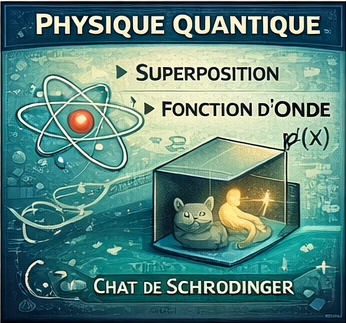
What Is Schrödinger’s Cat? The Setup
In 1935, physicist Erwin Schrödinger proposed a thought experiment to highlight what he saw as the absurdity of quantum mechanics when applied to the everyday world. It’s not a real experiment, but a story designed to make a point.
Imagine a sealed, soundproof box containing four things:
- A cat.
- A single radioactive atom.
- A Geiger counter that can detect if the atom decays.
- A hammer connected to the Geiger counter, poised to shatter a vial of poison if the atom decays.
The rules are simple: there is a 50% chance the atom will decay in one hour. If it decays, the Geiger counter clicks, the hammer falls, the vial shatters, and the cat dies. If it doesn’t decay, the cat lives.
The Quantum Paradox: Alive AND Dead
According to our everyday logic, after one hour, the cat is either alive or dead. We just don’t know which until we open the box.
However, quantum mechanics says something far stranger. At the subatomic level, until it is measured or observed, the atom is not in one state or the other. It is in a “superposition” of both states at once—it has both decayed AND not decayed.
Because the cat’s fate is directly linked to the atom, the cat is also entangled in this quantum state. Therefore, until the box is opened and the system is “observed,” the cat is in a superposition of being both alive AND dead at the same time.
This is the paradox. Our intuition screams that a cat cannot be both alive and dead. It must be one or the other.
The Real Point of the Experiment
It’s crucial to understand that Schrödinger was not seriously suggesting a cat could be a zombie. He was using this extreme example to ask a question: Where does the quantum world end and the classical world begin?
- He found it absurd that the weird rules of the quantum realm (superposition) could be scaled up to describe a large, complex object like a cat.
- His experiment was a critique, designed to show that the “Copenhagen Interpretation” of quantum mechanics (which embraces superposition) must be incomplete if it leads to such a ridiculous conclusion.
So, What’s the Modern Answer?
Today, the most widely accepted explanation for why we don’t see zombie cats is a phenomenon called quantum decoherence.
In simple terms, a quantum system (like the atom) can only maintain its superposition if it is perfectly isolated. The moment it interacts with its environment—even a single air molecule, a photon, or the Geiger counter—the superposition “collapses” into one definite state.
In the box, the cat, the air, the Geiger counter, and the box itself are all part of the environment. Decoherence would happen almost instantly, forcing the atom to “choose” whether it has decayed or not long before we open the box. So, in reality, the cat is either alive or dead, not both. The paradox dissolves.