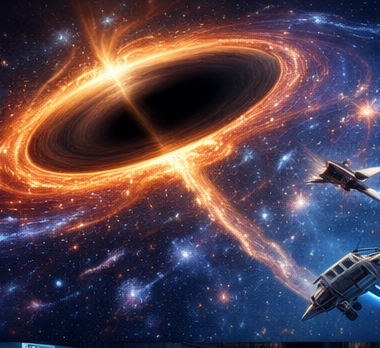
Black Hole Thermodynamics
What happens when you mix the laws of heat with the laws of gravity? Discover the revolutionary idea that black holes have temperature, entropy, and aren’t so “black” after all.
A Clash of Two Laws
For a long time, two pillars of physics seemed to be in direct conflict.
- General Relativity predicted the existence of black holes—objects so dense that nothing, not even light, can escape their gravitational pull. They were seen as perfect, simple objects described only by their mass, spin, and charge.
- The Second Law of Thermodynamics states that the total entropy (a measure of disorder or information) of an isolated system can never decrease. It always increases or stays the same.
The problem was simple: what happens if you throw a hot cup of tea (which has a lot of entropy) into a black hole? The tea disappears behind the event horizon, and it seems like the total entropy of the universe has just decreased, violating a fundamental law of physics. This was a major paradox.
Bekenstein’s Revolutionary Idea: Black Hole Entropy
In the early 1970s, a graduate student named Jacob Bekenstein proposed a radical solution. He noticed a strange similarity between the behavior of black holes and the laws of thermodynamics. For example, the surface area of a black hole’s event horizon never decreases, much like entropy.
Bekenstein made a bold leap: what if the entropy of a black hole is not zero, but is instead proportional to the **surface area of its event horizon**?
This formula states that the entropy of a black hole (S) is proportional to its surface area (A).
This meant that when the cup of tea falls into the black hole, the entropy of the outside world decreases, but the surface area of the black hole increases, and thus its own entropy increases by an even greater amount. The Second Law of Thermodynamics is saved!
Hawking’s Shocking Discovery: Black Holes Glow
Initially, many physicists, including the great Stephen Hawking, were skeptical. In thermodynamics, if an object has entropy, it must also have a **temperature**. And if it has a temperature, it must radiate energy, just like a hot piece of coal glows red.
But black holes, by definition, were supposed to be perfectly black. Nothing could escape. To prove Bekenstein wrong, Hawking set out to show that black holes could not radiate. Instead, by applying the rules of quantum mechanics to the edge of a black hole’s event horizon, he discovered the exact opposite.
Quantum mechanics says that “empty” space is not empty at all. It’s a bubbling sea of “virtual particles” that pop into existence as matter-antimatter pairs and then almost instantly annihilate each other.
Hawking realized that if a pair of these particles is created right at the edge of a black hole’s event horizon:
- One particle might fall into the black hole.
- The other particle, now without a partner to annihilate with, can escape into space.
To an outside observer, it looks as if the black hole is emitting a steady stream of particles. This is **Hawking radiation**. The black hole isn’t black—it glows with a faint thermal energy.
The Evaporation of Black Holes
The energy for this radiation has to come from somewhere. It comes from the black hole’s own mass, according to \(E=mc^2\). This means that black holes are not eternal. They slowly lose mass and “evaporate” over unimaginably long timescales. A solar-mass black hole would take about \(10^{67}\) years to evaporate—far longer than the current age of the universe.
The Information Paradox
This discovery solved one problem but created an even bigger one: the **Black Hole Information Paradox**.
- A core principle of quantum mechanics is that information can never be truly destroyed. It can be scrambled, but it’s always theoretically recoverable.
- Hawking radiation seems to be purely thermal, meaning it contains no information about what fell into the black hole.
- So, when a black hole completely evaporates, what happens to the information of all the things that fell into it? Does it vanish forever, violating quantum mechanics?
This paradox remains one of the biggest unsolved problems in theoretical physics and is a key driver in the search for a theory of quantum gravity.