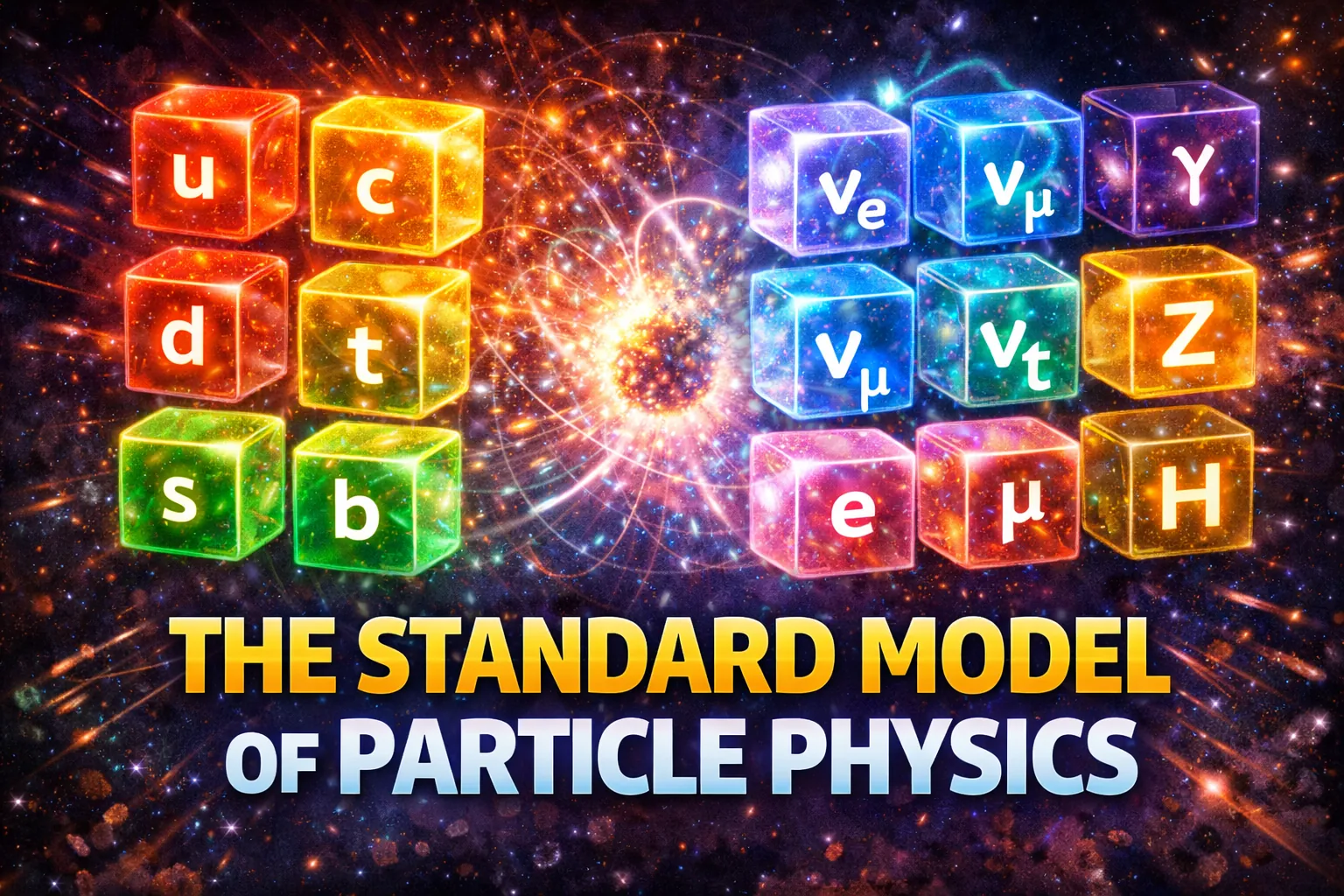
The Standard Model: Still Unbroken
Despite decades of attempts to find its limits, the Standard Model of particle physics remains the most precise and successful theory in the history of science — even as deep mysteries remain unsolved.
What Is the Standard Model?
The Standard Model of particle physics is our best framework for understanding the fundamental building blocks of matter and the forces that govern them. Think of it as the ultimate “recipe book” of the universe.
It classifies all known elementary particles — quarks, leptons, and bosons — and describes three of the four fundamental forces: electromagnetism, the weak nuclear force, and the strong nuclear force. Only gravity remains outside its scope.
Building blocks of protons & neutrons
Electrons & neutrinos
Force-carrying particles
Origin of mass
A Theory Tested to Extraordinary Precision
What makes the Standard Model extraordinary is not just its breadth, but its accuracy. Its predictions match experimental results to an almost unbelievable degree of precision.
Predicted by the Standard Model and confirmed by experiment to more than 10 significant figures — one of the most precise agreements in all of science.
In 2025, a major test came from the muon g-2 experiment at Fermilab. Scientists had long hoped this experiment would reveal a discrepancy between theory and measurement — a sign of undiscovered physics. Instead, improved theoretical calculations brought prediction and observation back into agreement. The Standard Model passed, once again.
New Evidence: CP Violation in Baryons
One of the biggest open questions in physics is why the universe contains more matter than antimatter. If the Big Bang produced equal amounts of both, they would have annihilated each other — leaving nothing behind.
The Standard Model predicts a phenomenon called CP violation: a slight difference in how matter and antimatter behave. In 2025, the LHCb experiment at CERN detected CP violation in particles called baryons for the first time — a landmark result that, again, aligns with Standard Model predictions rather than contradicting them.
What the Standard Model Cannot Explain
Despite its successes, the Standard Model is not a complete theory of everything. Several fundamental mysteries lie beyond its reach:
- Dark matter: about 27% of the universe is made of something we cannot detect directly — the Standard Model offers no candidate particle
- Dark energy: the force accelerating the expansion of the universe remains unexplained
- Gravity: general relativity and the Standard Model are incompatible at the deepest level
- Matter–antimatter asymmetry: the known CP violation is far too small to explain why matter dominates the universe
- The hierarchy problem: why is the Higgs boson so much lighter than theoretical expectations?
Is the Standard Model Just a Stepping Stone?
Physicists have proposed many extensions to go beyond the Standard Model — supersymmetry, extra dimensions, string theory — but so far, none have found experimental confirmation. The model refuses to break.
In the same way that Newtonian mechanics remained the best framework for centuries before Einstein extended it, the Standard Model may simply be an extraordinarily good approximation of a deeper, yet-to-be-discovered theory.
Looking Ahead
Future experiments at the Large Hadron Collider, next-generation neutrino detectors, and new dark matter searches all aim to push the Standard Model to its breaking point. Until that moment arrives, it remains the most powerful and precise scientific theory ever constructed.