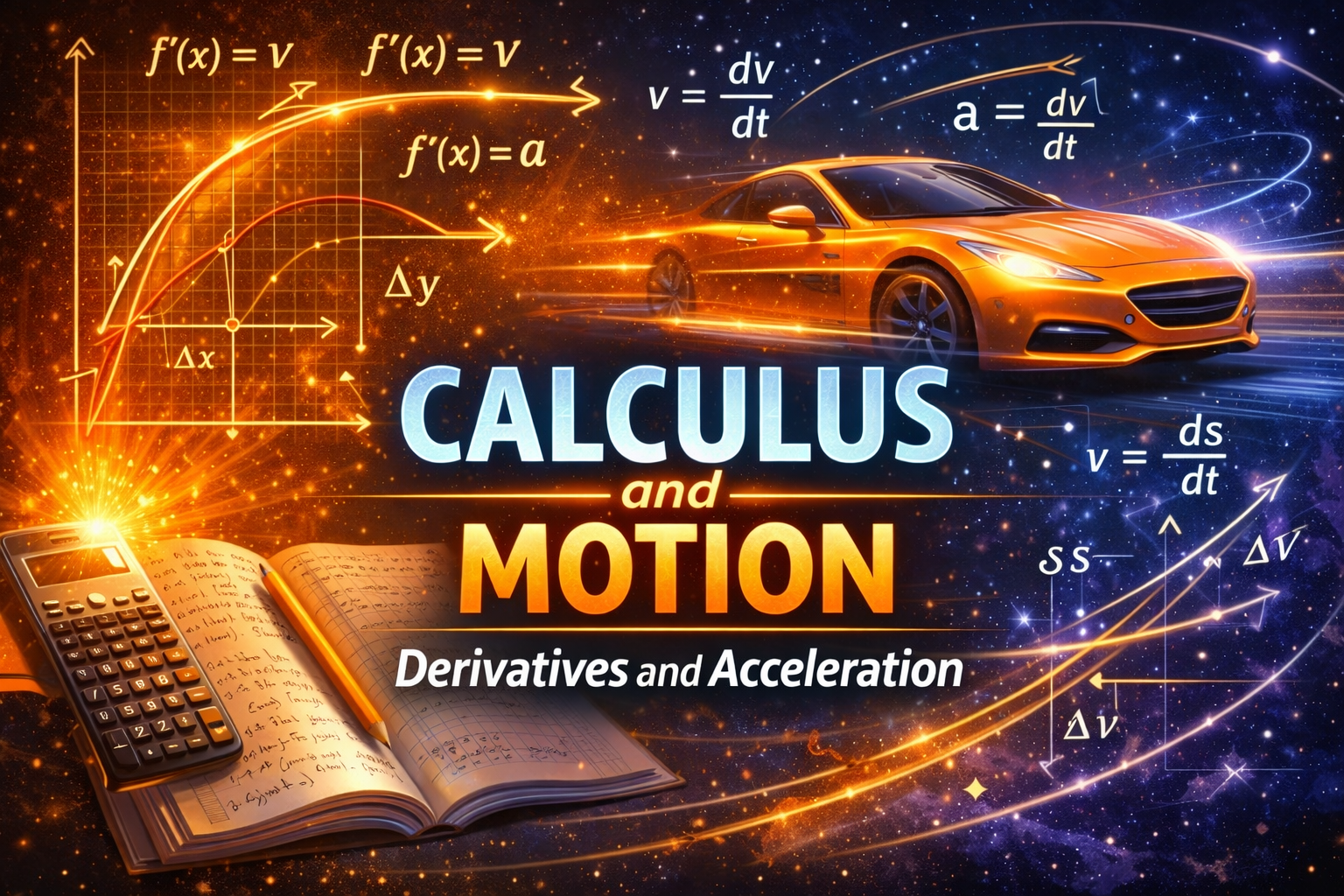
Calculus and Motion
Calculus provides the mathematical language needed to describe motion. Using derivatives and integrals, physicists can calculate velocity, acceleration, and trajectories.
Why Motion Requires Calculus
In classical physics, motion is described by how the position of an object changes with time. To understand these changes precisely, scientists use calculus, a branch of mathematics developed independently by Isaac Newton and Gottfried Wilhelm Leibniz.
Calculus allows us to move from simple observations of motion to precise mathematical descriptions used in physics and engineering.
Position and Velocity
If the position of an object is described by a function \(x(t)\), then its velocity is defined as the derivative of position with respect to time.
This equation tells us how fast the position of the object changes over time.
Acceleration
Acceleration describes how velocity changes with time. In calculus, it is the derivative of velocity.
Acceleration is crucial for understanding forces, since Newton’s second law relates force directly to acceleration.
Integrals and Motion
While derivatives describe rates of change, integrals perform the opposite operation. They allow us to reconstruct position from velocity or velocity from acceleration.
This dual relationship between derivatives and integrals forms the mathematical backbone of classical mechanics.
For a deeper mathematical explanation, see the Stanford Encyclopedia of Philosophy entry on calculus .
Calculus in Modern Physics
Calculus is not limited to classical mechanics. It also appears in:
- electromagnetism
- quantum mechanics
- fluid dynamics
- general relativity
Without calculus, modern physics and engineering would be impossible.