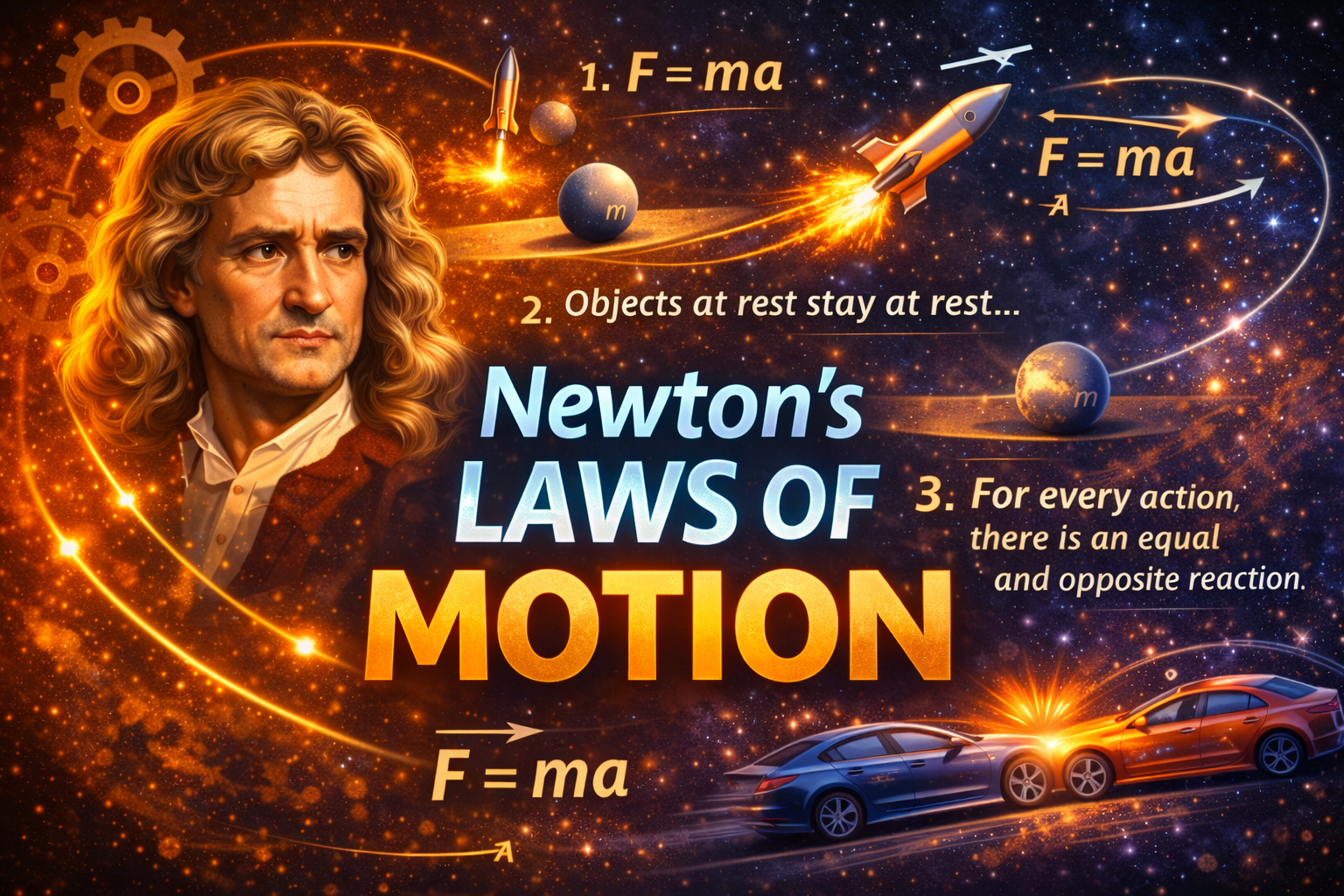
Newton’s Laws of Motion
The three laws of motion introduced by Isaac Newton form the foundation of classical mechanics and explain how forces influence the motion of objects.
The Birth of Classical Mechanics
In the 17th century, the English physicist Isaac Newton published his famous work Philosophiæ Naturalis Principia Mathematica. In this book he formulated three fundamental laws that describe how objects move under the influence of forces.
These laws remain essential in modern science and engineering. They are still used to calculate the motion of cars, satellites, rockets, and even planetary orbits. A detailed historical explanation can also be found on the Encyclopaedia Britannica page on Newton’s laws.
First Law: The Principle of Inertia
Newton’s first law states that an object remains at rest or continues moving in a straight line at constant velocity unless acted upon by a net external force.
Second Law: Force and Acceleration
The second law connects force, mass, and acceleration. It tells us that applying a force to an object causes it to accelerate.
Here:
- F — Force applied to the object
- m — Mass of the object
- a — Acceleration produced
This equation is one of the most important relationships in physics and is discussed in detail in classical mechanics.
Third Law: Action and Reaction
Newton’s third law states that whenever one object exerts a force on another, the second object exerts an equal and opposite force on the first.
This law explains how rockets move in space. When a rocket pushes gas backward, the gas pushes the rocket forward.
Space agencies like NASA use these principles constantly when calculating trajectories for spacecraft.
Why Newton’s Laws Matter
These three simple principles explain a vast number of physical phenomena:
- motion of planets
- trajectories of projectiles
- vehicle dynamics
- engineering mechanics
Although modern theories such as relativity and quantum mechanics extend beyond Newton’s framework, classical mechanics remains extremely accurate for everyday phenomena.