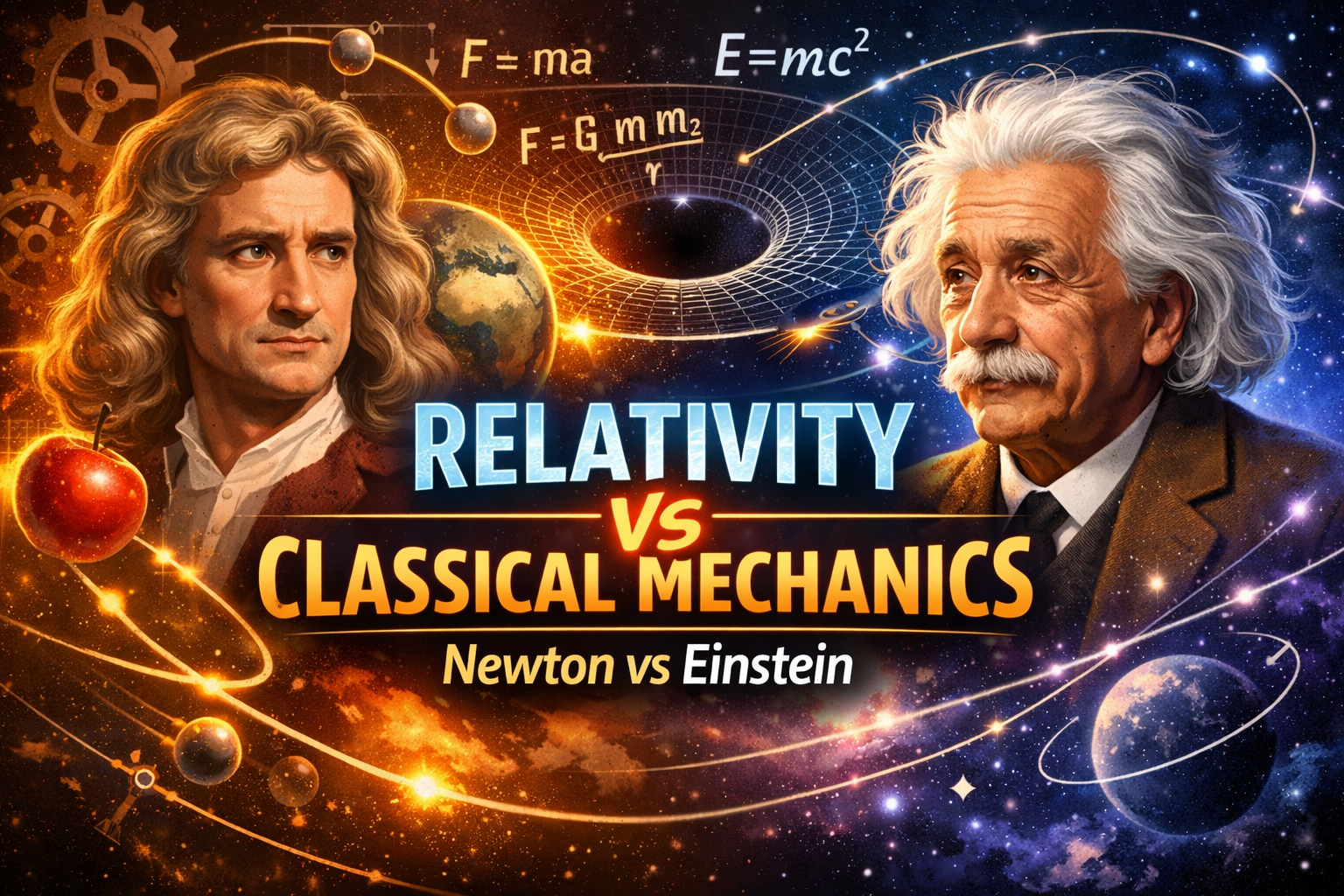
Relativity vs Classical Mechanics
Classical mechanics describes motion accurately for everyday objects, but at very high speeds or strong gravitational fields, Einstein’s theory of relativity becomes necessary.
The Limits of Newtonian Physics
For more than two centuries, the laws of classical mechanics accurately described the motion of objects on Earth and in the Solar System.
However, physicists discovered that these laws begin to break down when objects move close to the speed of light or when gravity becomes extremely strong.
Einstein’s Special Relativity
In 1905, Albert Einstein introduced the theory of special relativity. This theory revealed that space and time are not absolute but depend on the motion of the observer.
This equation shows that mass and energy are fundamentally equivalent. It also explains phenomena such as nuclear energy and particle physics.
General Relativity and Gravity
Ten years later, Einstein extended his work to gravity through the theory of general relativity. Instead of describing gravity as a force, Einstein described it as the curvature of spacetime.
Massive objects like stars and planets bend spacetime around them, and other objects follow these curved paths.
When Each Theory Works
- Classical mechanics: everyday speeds and engineering
- Special relativity: objects moving near the speed of light
- General relativity: strong gravitational fields and cosmology
Despite its limitations, classical mechanics remains extremely accurate for most practical applications. Even space agencies such as NASA often begin calculations using Newtonian physics before applying relativistic corrections.
The Evolution of Physics
Modern physics does not replace Newton’s work entirely; instead, it extends it. Newtonian mechanics remains an approximation that works extremely well in everyday situations.
Relativity simply reveals a deeper structure of the universe when extreme conditions are involved.