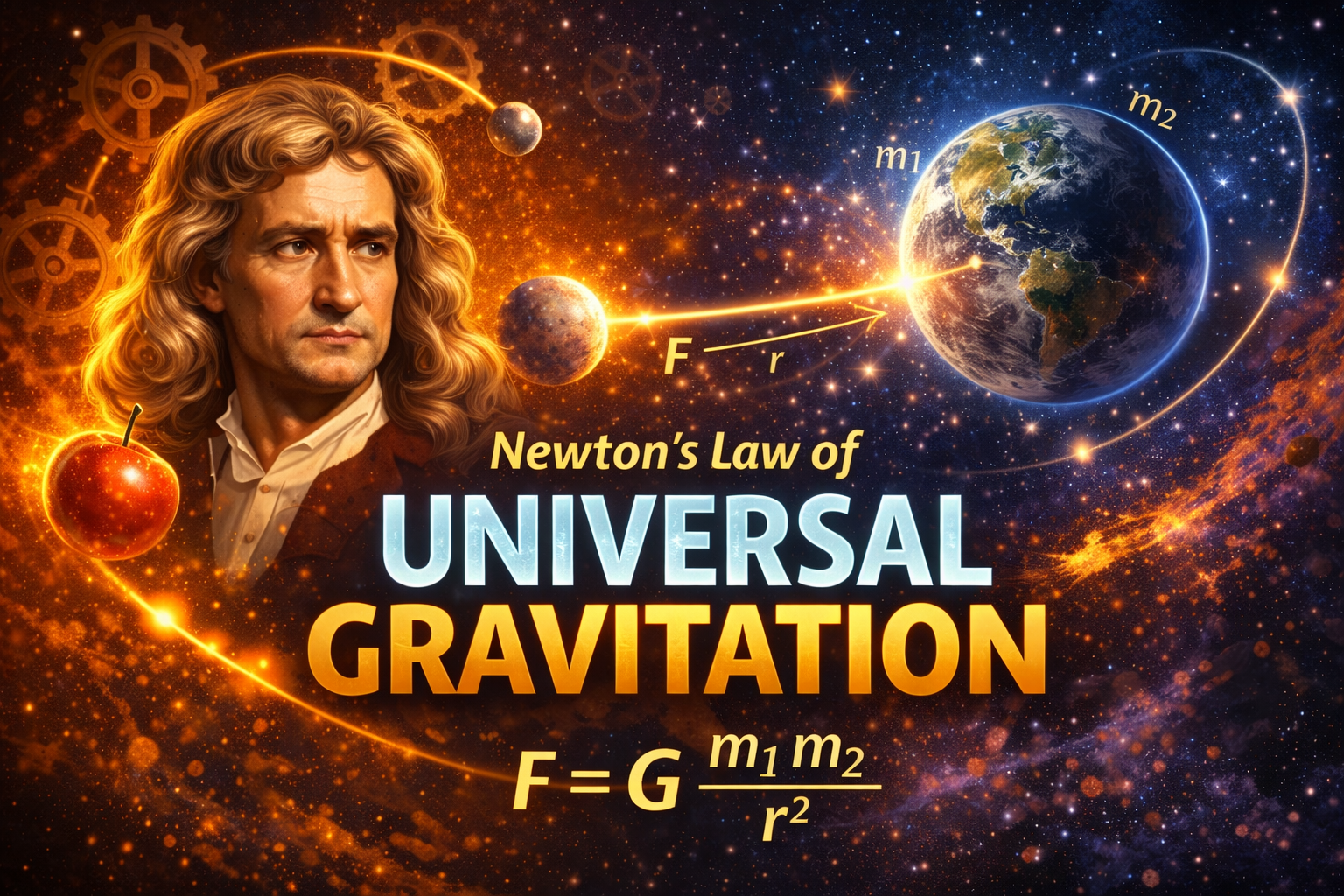
The Law of Universal Gravitation
Newton’s law of universal gravitation explains why planets orbit the Sun, why objects fall to Earth, and how gravity governs the motion of the universe.
The Discovery of Gravity
In the 17th century, Isaac Newton formulated the law of universal gravitation after studying the motion of the Moon and the fall of objects on Earth.
Newton realized that the same force responsible for an apple falling from a tree also governs the motion of the Moon and planets. A detailed historical overview can be found in the Britannica explanation of Newton’s gravitation law .
The Universal Gravitation Formula
Newton proposed that every object in the universe attracts every other object with a force proportional to their masses and inversely proportional to the square of the distance between them.
Where:
- F — gravitational force
- G — gravitational constant
- m₁ and m₂ — masses of the objects
- r — distance between their centers
Gravity and Planetary Motion
Using this law, Newton successfully explained the planetary motions previously described by Johannes Kepler .
This connection between gravity and planetary motion forms the basis of classical astronomy and orbital mechanics. Modern space missions calculated by agencies like NASA still rely heavily on Newton’s gravitational theory.
Why the Inverse Square Law Matters
The inverse square relationship means that gravity weakens rapidly with distance. If the distance between two objects doubles, the gravitational force becomes four times weaker.
This mathematical relationship explains why planets far from the Sun experience much weaker gravitational attraction.